
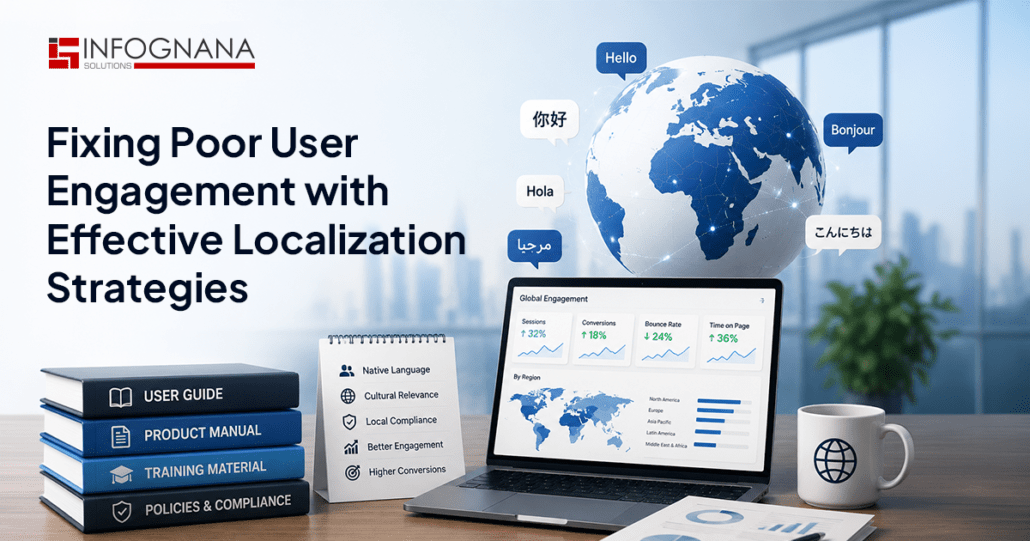
Fixing Poor User Engagement with Effective Localization Strategies
At first glance, global traffic numbers look impressive. Sessions and page views are rising, and visitors are coming from new countries. But when you check conversion data, the story changes. Bounce rates go up, time on page goes down, and conversions in new markets are much lower than at home. Marketing blames the creative team, while product blames pricing. Often, though, the real issue is simpler and more challenging to solve.
CSA Research found that 76% of consumers prefer to buy in their own language. In fact, 90% choose websites in their native language when possible, and 40% will never buy from a site that isn’t localized. The engagement gap rises from language and context. Enterprises close this gap with localization and publishing services, turning visitors into customers in every market.
What Poor User Engagement Actually Looks Like in Global Markets
Once you know what to look for, the signs are everywhere. There’s drop-off on the pricing page in Japan, form abandonment on the contact page in Germany, and support tickets sent to English-speaking agents from customers writing in Portuguese. Some product pages are machine-translated, but still show home-market currency, units, date formats, and cultural references.
Each issue might seem small on its own, but together they point to one thing: the experience wasn’t designed for the market it’s serving. For people with limited English, the gap is even bigger. 89% of buyers with no English skills prefer information in their own language, and three out of four will remain loyal only if customer care is also available in their language.
Why Translation Alone Doesn’t Fix It
Translation changes the words, but localization adapts the whole experience. The difference is that translation makes a website readable, while localization makes it feel natural to the user. A literal translation might keep all the terms correct, but still lose visitors with the wrong tone, examples, currency, or layout for languages that read right to left. Localization solves these problems.
Good localization strategies focus on the user first, not just the original text. They think about how people in each market read, shop, and make decisions, as well as what local regulators expect. They also consider how typography, images, and white space appear in different places. When done poorly, it’s often the main reason global engagement falls short.
How Effective Localization Strategies Restore Engagement
Website Localization Services That Go Beyond Text
A website is more than just its text. Website localization services adapt everything from navigation, forms, checkout, to search, currency, tax, shipping, legal text, and metadata. Research shows that multilingual websites can generate 25-70% more sales, a 47% boost in organic search traffic, and a 70% increase in total visits after localization. These gains are significant. It means the whole funnel is finally working.
Document Localization That Respects Context
Sales materials, onboarding kits, manuals, training guides, and contracts all represent your brand in customer interactions beyond the website. Document localization gives these assets the same careful attention, adapting language, images, examples, and legal terms for each market. In regulated industries, this is essential. Health, finance, legal, and life sciences companies depend on document localization to stay compliant everywhere they operate.
Multilingual Desktop Publishing That Preserves Design Integrity
Translated text often doesn’t fit the original layout. For example, German is about 30% longer than English, Japanese uses shorter visual blocks, and Arabic and Hebrew read right to left. Without multilingual desktop publishing that respects each language’s style and layout, brand documents can look unprofessional just when customers need to trust them. Multilingual desktop publishing keeps PDFs, datasheets, and presentations on-brand across every locale.
Cultural and Regulatory Adaptation
Color symbolism, images, idioms, holiday calendars, and naming traditions all have meanings that don’t always translate directly. Cultural and regulatory adaptation helps avoid mistakes and turns the experience into one the local audience recognizes as their own. This is also where compliance happens, including labeling rules, accessibility standards, and consumer protection notices that differ by country.
Localization is one of the rare investments that boosts both engagement and revenue. Three out of four businesses see a big increase in user engagement after adding localized content. Companies localizing for two markets see 16.4% more conversions, while those localizing for three or more see 18.2%. Localized ad campaigns get 86% higher click-through and conversion rates than English-only ones.
Why Choose Infognana as your Localization and Publishing Services Partner
Infognana’s localization and publishing services offer 25 years of experience in multilingual delivery for enterprise programs. Our team brings together native-speaking translators and subject-matter experts, providing professional translation in over 50 languages. We offer website localization for digital products, document localization for regulated industries, and multilingual desktop publishing for all major design systems. ISO 9001:2015 quality controls and project management ensure reliable turnaround in every market you enter.
Contact our localization and publishing expert to close your global engagement gap.
