
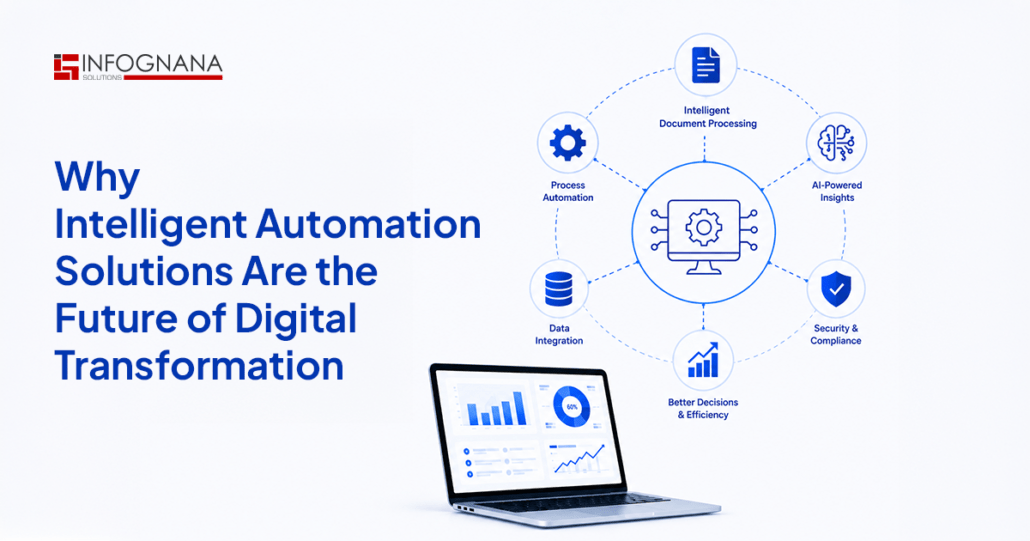
Why Intelligent Automation Solutions Are the Future of Digital Transformation
For years, digital transformation has been a top priority for businesses. Many have moved to the cloud, set up dashboards, and expanded their SaaS tools. Yet, much of the daily work still relies on people manually copying data from one screen to another. Even after cloud migrations, many workflows still require employees to move data between systems, read documents individually, and make decisions in spreadsheets. The technology is digital, but in many cases, the actual work is not.
That gap is where intelligent automation solutions are changing the future of digital transformation. Research shows that companies can achieve 25-45% higher productivity, cut costs by 20-60%, and reduce process times by 40% with intelligent automation at scale. In fact, 76% of businesses achieve a positive return on investment within a year, and 12% within a month. The technology has moved beyond pilot projects, and companies that act now will set the standard for operating costs in the years ahead. Automation is the convergence of three previously separate disciplines: robotic process automation (RPA), artificial intelligence, and orchestration. RPA handles the rules. AI handles the judgment. Orchestration ties them together into end-to-end workflows that span systems, departments, and decisions. The shift from RPA to intelligent automation is what makes that convergence possible. Bots are no longer just clicking buttons. They’re reading documents, interpreting context, and learning from every transaction.
What matters most is what intelligent automation can do, not what it’s called. These solutions can read unstructured documents as easily as structured ones. They send exceptions to people without disrupting the workflow and learn from corrections over time. In practice, this means automation can now handle the complex, everyday tasks in a business, not just the simple, repetitive ones.
Why Digital Transformation Needs Intelligent Automation Solutions
Traditional automation often fails when something changes, like a new invoice template or a different vendor format. AI-powered automation is designed to handle these changes. Vision models read documents, language models understand the content, and rules engines apply business logic. Intelligent process automation helps teams move beyond simple scripts to systems that can actually reason through their work.
RPA focused on individual tasks, while intelligent automation manages entire workflows. For example, when an invoice comes in, it can be classified, validated, matched to a purchase order, approved or escalated, and posted to the ERP system, all without manual steps. These workflows can reduce repetitive work by 60-95% and save teams up to 80% of the time they spend on routine tasks. The goal isn’t to replace people, but to remove the parts of the job that don’t need human judgment.
Where is the Future Headed with AI-powered Automation
Market data shows that the next phase is already underway. The intelligent process automation market is expected to exceed $37 billion by 2030, growing at nearly 10% annually. Within this, the agentic AI segment includes autonomous AI agents that handle multi-step workflows without human help. In short, future workflows will mostly run on their own, with people setting goals and reviewing results instead of handling every step.
This future won’t happen everywhere at the same pace. Studies show that 70-85% of AI projects still fail to scale, often because the data isn’t ready or the workflows weren’t built for automation. The companies that succeed are those that invest in the basics: clean data, clear processes, and governance that allows bots to work safely with people.
Why Partner with Infognana for Intelligent Automation Solutions
Infognana’s intelligent automation solutions are backed by 25 years of experience in data operations and software engineering. We bring together AI-powered automation, process automation workflows, and data extraction, all built on enterprise-level digitization. Whether you’re starting with one high-volume process or a larger transformation, our engineering approach ensures accuracy, security, and reliable results.
